Spotlight on Outreach and Engaging the Public
Outreach Experiences

This issue highlights outreach experiences with contributions from Zelijka Popovic, a graduate student & Daniel Davis, a post-doc, both from the National High Magnetic Field Laboratory at Florida State University (FSU).
Communities thrive when people take the time to give back. Educational outreach events truly have made an impact on my life by providing supplemental learning in an interactive way. Over the years, these events taught me various learning techniques and made me realize that I am a visual hands-on learner. This helped me a lot with being able to verbalize my educational needs and motivated me to give back. I was thrown into outreach work with my undergrad’s American Chemical Society chapter. My undergrad is in a low socio-economic region in Georgia known for lack of school funding. We performed chemistry “magic shows” using common fun reactions such as elephant paste to teach various science concepts. Most of our work was focused on the local community, but we would travel over an hour to schools and community centers in the region as well. In addition to the shows, we would also host a whole week of events for the community during the ACS National Chemistry Week. Starting my first year, I was manning the liquid nitrogen ice cream station and I looked forward to it every year. I loved standing there for hours and watching people of all ages be amazed by the ice cream science magic.
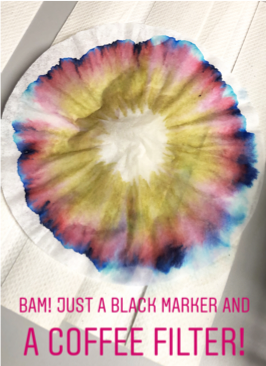
Going into graduate school, I knew I wanted to continue doing outreach work and was delighted to learn about allthe opportunities at the National High Magnetic Field Laboratory. Yearly, we have a lab-wide open house where we do various demonstrations related to our research fields. I help organize demonstrations, with chromatography butterflies being my favorite. Chromatography plays a critical role in my personal research, and it is great to be able to share and connect with the community in such a way. In addition to the demonstrations, I also make flyers for families to take home and do additional chromatography experiments where they can learn more about the science behind the experiments. To further the connection between the MagLab and the community, we include graphics relating the demos directly to the research we do.
The MagLab has also opened doors to community outreach outside of the lab. Throughout the year we receive emails requesting volunteers for science fair judging at local schools and regional events. Not only are the students beyond thankful to have real scientists judge, but they truly impress you with their work. The students continue to impress during our ‘Ask a Scientist’ events, where weekly through the summer students meet with scientists and ask any questions they want. It shows the diversity and variety of scientists at the lab and the students will really make you pause and think with their questions. Lastly, one of the largest outreach events that I participate in is the Tallahassee Science Festival. This festival is put on by various STEAM organizations, businesses, and interest groups around the area in downtown Tallahassee. The community in Tallahassee is truly invested in learning more and taking advantage of the outreach opportunities in their full capacity.


Contributed by Zelijka Popovic
 Excitement! How often do scientists get to talk about the most interesting parts of their research field, the things that led them to want to dedicate their lives (professional and personal) to studying a small part of it? I was privileged as a graduate student to work with Ernesto S. Bosque who annually mentored middle school students. I would be in the lab preparing superconducting wire samples for testing and hear the students get exposed to the fundamentals of electricity for the first time, in the context of building ultra-high field zero-resistance superconducting magnets cooled with liquid helium at 4 Kelvin above absolute zero. Ernesto and I followed the parallel paths (Physics/Engineering) at FSU from undergraduate to graduate school to a post-doc at the National High Magnetic Field Laboratory, so we understood each other well and were used to relying on the other on theoretical/practical topics. This benefited us well in our research and development (R&D) group for developing prototype magnet technologies, where an egalitarian, “ideas-first” approach was common. So, with the middle school student, my colleague was quick to admit the limits of his knowledge and I enjoyed jumping in to explain the quirkiness of AC circuits and storing energy in a magnetic field for inductors. Our excitement and comradery were reflected in the mentee’s energy while building their first electromagnets and trying to explain back to us the results they got from measuring the current and magnetic field strength. It’s a joy to see the lessons that were hard-won for me in my studies become a basis for mentees creative new ideas.
 I’ve now been a mentor for two years, learning and growing as a mentor with each new pair of students, especially when the challenges of COVID enforced remote interaction requiring greater planning and coordination. I have learned to prepare a concrete set of milestone goals for each session, to rely on the wonderful organizers, headed by Carlos R. Villa of the Center for Integrating Research and Learning (CIRL), at the MagLab, as well as other mentors’ expertise, and to try not to fall into the trap of taking on too much. The first year I partnered with Abiola Temidayo Oloye and I feel that our differences (field of study/gender/ethnicity/country of origin) were important examples that like the mentees, scientists have a variety of looks and interests and work together. Brainstorming sessions with other mentors and the program organizers ahead of time helped me cement my plans and build on other people’s great ideas, without overlapping their projects too much. For this age group (11-14 yrs), I learned to keep tasks to flexible 10 to 20 minute segments, with breaks or shifts to different content types (demos, theory, real-world examples, online research, calculations, and brainstorming) to avoid mental fatigue and make the best use of limited time. Repeat, repeat, repeat important content, even if students appear to understand, as they have much going on outside of this program, vying for recall. I find it most exciting when we develop an interesting circuit application naturally out of our discussions as in the case of using LEDs to rectify AC into DC to charge a battery, and then taking a slow-motion video with our phone cameras to see the LEDs turn on and off at 60 Hz. Each year, I am impressed by the mentees top-notch circuit analysis and poster presentations.
![(Left) Materials for a remote mentoring program. (Middle) Building a circuit collaboratively on zoom. (Right) LED rectified battery charger to demonstrate wireless [inductive] power transfer. Image Credit: Daniel Davis](https://higherlogicdownload.s3.amazonaws.com/APS/b78b34eb-fd8b-4522-bbc5-d1874657d1bb/UploadedImages/Davis_2.png "(Left) Materials for a remote mentoring program. (Middle) Building a circuit collaboratively on zoom. (Right) LED rectified battery charger to demonstrate wireless [inductive] power transfer. Image Credit: Daniel Davis")
Despite multiple roles that can be part of being a mentor, a common core of mentorship is investment in the success of the mentee. Mentoring can include being a role model, a teacher, a confidant, an active listener, or a champion. Intergenerational mentoring makes one recognize their part in continuing and expanding our communities, this is especially necessary for science as a collaborative enterprise, where new discoveries are enabled by foundational work that can span multiple lifetimes and many fields of study. I enjoy being part of something greater than myself, made possible because of the awesome places I get to work at and the people they bring together. Building interest and motivating mentees to gain skills is best done as early as possible. The best time to prepare the next generation of scientists was a decade ago, the second-best time is today. In my experience, middle school is where you begin to develop mature ideas of the subjects you study, and begin to understand, with some work, the real complexities in the world. It is when I cemented my own enjoyment of math and science.
 For a wider audience, our annual open house demonstrations, organized by Kristin Roberts of MagLab Public Affairs, draw an audience of thousands of people every year. My first year in research, I demonstrated superconducting flux pinning by levitating dinosaurs on liquid nitrogen cooled bulks. Without this forum I would almost never have conversations at the varying levels of complexity required to talk to people with a wide range of ages and backgrounds. This pushes me to find new ways to explain and demonstrate our science. While this can be draining, as it is difficult to relate much of the science that I find most interesting without a significant amount of uncommon background knowledge, I understand part of the motivation is to build that foundation and make it all the more accessible.
Supporting all this outreach is a huge investment of time, effort, and patience. It is important for institutions that value outreach to recognize and reward this effort as a core part of the job, valued on an equal footing with research and teaching, not tacitly expected as extra volunteer hours. The NHMFL demonstrates this with a core outreach team at our Center for Integrating Research and Learning, participation in the Open House, efforts to make mentoring a regular part of a researcher’s day, and including outreach in evaluations.
 Contributed by Daniel Davis